In the professional world, a diploma is more than just a piece of paper; it is a symbol of years of dedication, financial investment, and intellectual growth. However, for many alumni, the original document is too precious—or too fragile—to be exposed to the elements. This has led to a sophisticated industry focused on creating a realistic diploma that can stand in for the original. To the untrained eye, any replica might suffice, but for the discerning professional, the “anatomy” of a high-end fake degree involves a complex interplay of materials science, digital cartography, and heraldic art.
The foundation of any authentic-looking document is the substrate. Standard office paper, typically 80gsm, lacks the gravitas required for a university credential. A realistic diploma must be printed on archival-grade parchment, usually weighing between 120gsm and 150gsm. This specific weight provides a tactile “snap” and a structural rigidity that prevents sagging when framed. At DiplomaAssist, we utilize PH-neutral, acid-free ivory parchment. This is crucial because standard paper contains lignin, which causes yellowing and brittleness over time when exposed to oxygen. By using archival materials, a fake diploma becomes a lifetime keepsake that resists the ravages of time.
Beyond the paper, the typography and layout demand mathematical precision. Universities often use proprietary or highly customized serif fonts that cannot be found in standard word processors. To create a realistic diploma, every character must be vectorized. Vectorization ensures that the edges of the letters remain razor-sharp, avoiding the “pixelation” or blurriness common in low-quality scans. The kerning—the micro-space between individual letters—must be manually adjusted to match the institution’s historical printing standards. When you look at a premium fake degree, the text should appear as if it were pressed into the paper, not just sitting on top of it.
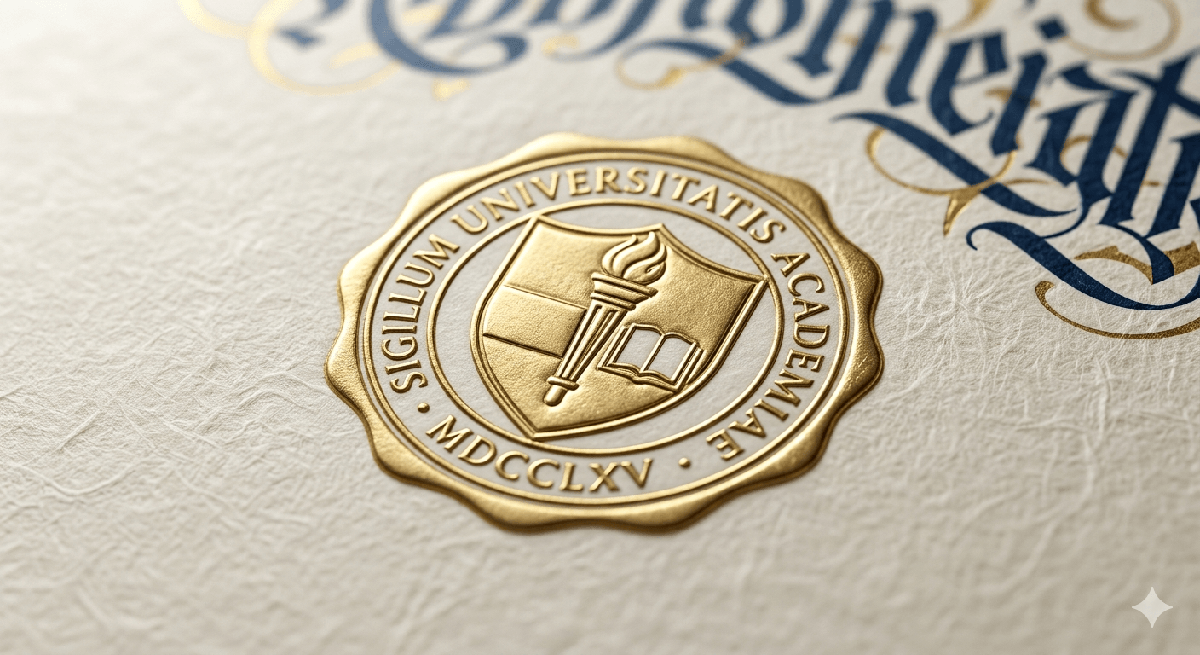
The most critical component, however, is the institutional seal. This is where most replicas fail. A flat, printed yellow or gold circle is an immediate giveaway of a non-authentic document. A truly realistic diploma utilizes high-pressure gold foil embossing. This process involves a custom-engraved metal die that strikes the foil into the parchment using intense heat and several tons of pressure. This creates a multi-dimensional, tactile 3D effect. When light hits the crest, it should cast subtle shadows within the ridges of the design. This level of detail in a fake degree is what separates a “prop” from a professional-grade replacement.
Finally, we must consider the signatures. A realistic diploma features signatures that mimic “wet ink.” Rather than flat, digital images, we use stroke-path technology to replicate the natural flow and varying pressure of a fountain pen. This ensures that the Vice-Chancellor’s or Registrar’s signature has the slight imperfections and ink density variations found in a hand-signed document. By combining these anatomical elements—archival parchment, vectorized typography, 3D embossing, and wet-ink signatures—DiplomaAssist delivers a realistic diploma that honors your academic legacy with absolute dignity and prestige.