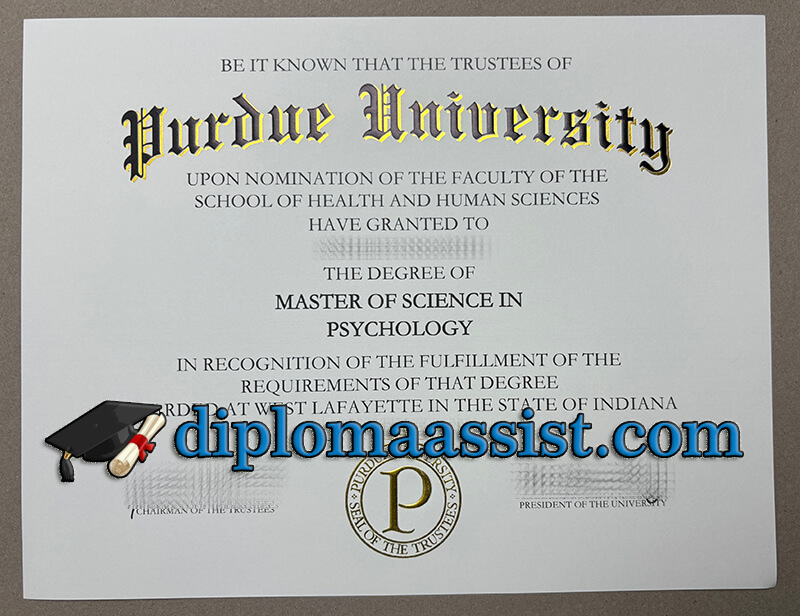
The Engineering of Authenticity: Decoding the High Detail of a Purdue University Diploma
At Purdue University, precision isn’t just a concept; it is a foundational religion. From the aerodynamic testing in their wind tunnels to the micron-level tolerances required in their mechanical engineering labs, Boilermakers are trained to obsess over the microscopic details that others overlook. Buy a Purdue University diploma, get a Purdue University degree. Can I order a Purdue University certificate?
It is this exact engineering mindset that one must apply when evaluating the market for academic document reproduction. For the discerning eye, 95% accuracy is a failing grade. If you are looking to purchase a Purdue University diploma, the baseline requirement is not just a piece of paper with your name on it—it is the demand for high detail.
In the world of high-end archival printing, “high detail” does not refer to using a nice font. It refers to the forensic-level replication of security features, paper topology, and complex embossing geometries. Here is a technical breakdown of what true high-detail reproduction entails when replicating a Purdue credential. order Purdue University diploma, buy a degree online.
The Topology of the University Seal
To the untrained eye, a university seal is just a stamped logo. Under magnification, however, it is a complex topographical map. When you purchase a high-detail Purdue diploma, the first element that must pass rigorous scrutiny is the seal.
Standard replica printers use a flat, foil-stamped sticker. A high-detail reproduction utilizes a physical, male-and-female brass die to create a true blind emboss, combined with a localized foil application. The technical marker of success? Edge definition. In a high-detail print, the raised edges of the Boilermaker Special or the shield emblem must be razor-sharp, without any “bleed” of the foil into the recessed areas of the paper. The depth of the emboss must precisely match the micron-depth of the era-specific original.
Micro-Text and Guilloché Patterns
Modern security printing—and the legacy printing methods used by universities in the 80s and 90s—relies heavily on line-work. If you look closely at the borders of an authentic Purdue diploma, you will often find Guilloché patterns: extremely complex, intersecting geometric lattices that are incredibly difficult to replicate without specialized software.
Furthermore, high-detail printing often incorporates micro-text. This is a line that looks solid to the naked eye but, under a jeweler’s loupe, reveals itself to be tiny, perfectly spaced text repeated thousands of times. When you procure a high-detail replica, the print shop must use high-DPI commercial lithographic presses capable of resolving these microscopic lines without causing them to blur or “muddy” together.
Spectral Color Matching and Substrate Physics
Purdue’s official colors are Old Gold and Black. However, ink behaves differently depending on the material it is applied to. A high-detail replica requires spectral analysis (often using Pantone color matching systems) to ensure that the gold foil and black offset inks perfectly mimic the light-refractive properties of the originals.
The substrate (the paper itself) is equally critical. Authentic diplomas use specialized cotton fiber paper, often containing hidden security watermarks that only appear when held up to a backlight. A high-detail provider doesn’t just buy thick paper; they source custom-milled, 100% cotton rag stock that possesses the exact translucency and snap of the university’s preferred vendor.
The Optics of Signature Layout
The layout of a diploma is an exercise in optical balancing. The kerning (the space between letters), the leading (the space between lines), and the exact x-y coordinates of the signature lines must be mathematically plotted. If a replica places the President’s signature line even two millimeters off-center relative to the Dean’s line, the entire document looks “wrong” to the human brain, even if the viewer can’t articulate why. High-detail means adhering to a strict grid system derived from the original era’s typography rules.
The Boundary of Technical Admiration
Applying an engineering lens to a Purdue University diploma replica allows one to truly appreciate the invisible artistry of security printing. It is a fascinating study in material science and graphic design. However, this technical appreciation comes with a strict ethical boundary.
A high-detail replica is a masterclass in printing mechanics—a showpiece for a personal study or a bench-mark for printing professionals. It is engineered for visual perfection, but it is fundamentally a novelty item. It cannot, and should not, be used to bypass digital background checks, secure employment, or falsify academic standing. For those verifications, only a cryptographically verified transcript from the Purdue Registrar holds value.
When you set out to purchase a Purdue University diploma, don’t settle for a superficial copy. Demand high detail. Evaluate the embossing depth, inspect the line resolution, and appreciate the document not just as a certificate, but as a triumph of precise manufacturing.