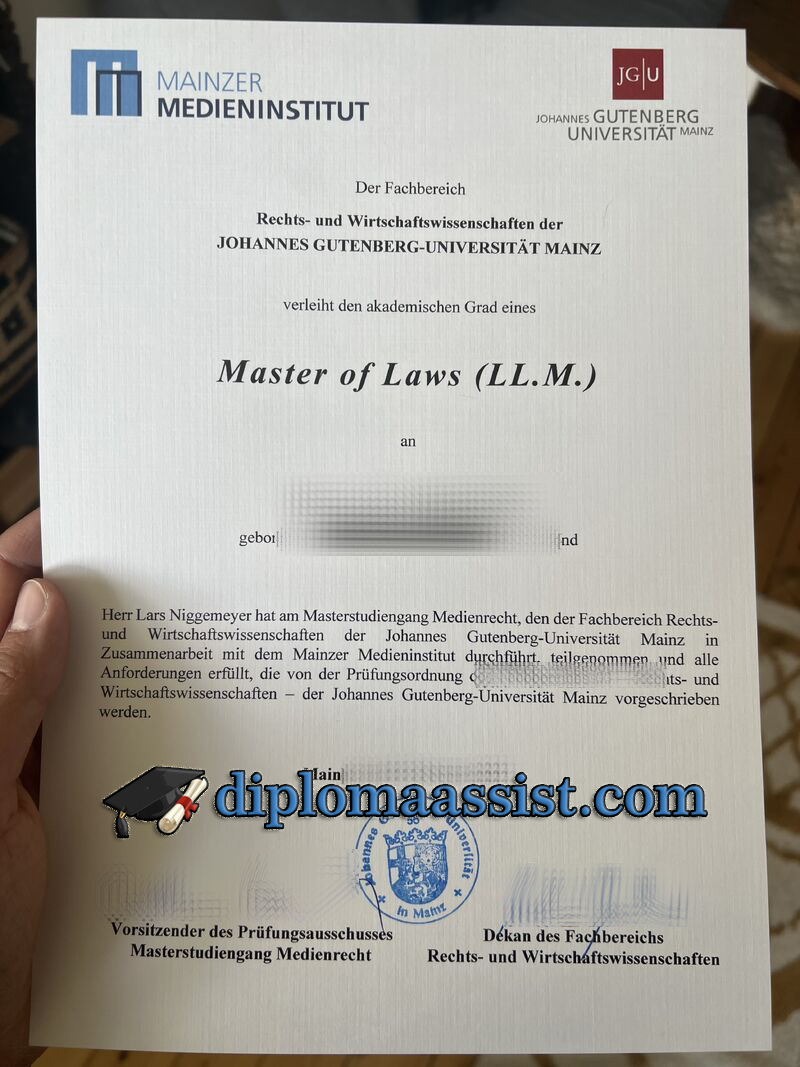
Buy Johannes Gutenberg-Universität Mainz Diploma: A Complete Guide to Replicating Your Academic Achievement
Johannes Gutenberg-Universität Mainz (JGU) , or Johannes Gutenberg University Mainz, stands as one of Germany’s most distinguished and historic institutions of higher learning. get diploma in Germany. Founded in 1477 and named after the father of the printing revolution, Johannes Gutenberg, this comprehensive university carries a legacy of spreading knowledge that spans more than five centuries.
With approximately 33,000 to 37,000 students from over 130 nations, JGU is one of the ten largest universities in Germany and the only comprehensive university in the state of Rhineland-Palatinate. Its unique structure combines almost all academic disciplines under one roof, including the Mainz University Medical Center, the School of Music, and the Mainz Academy of Fine Arts—a distinctive feature in the German academic landscape.
For alumni of this prestigious institution, the JGU diploma represents far more than a certificate of graduation. It symbolizes years of intellectual growth, groundbreaking research participation, and personal achievement at a university that has shaped thinkers since the medieval era. Whether your original document has been lost during an international move, damaged over time, or you simply wish to preserve your primary copy while displaying a replica, understanding how to obtain a high-quality reproduction of your Johannes Gutenberg-Universität Mainz diploma is a practical consideration for many graduates.
The Legacy of Johannes Gutenberg University Mainz
Before exploring diploma replication, it is essential to appreciate the profound history and academic standing of this remarkable institution.
A Five-Century Journey of Knowledge
The University of Mainz was established in 1477 by Diether von Isenburg, Archbishop and Elector of Mainz, making it one of Germany’s oldest universities. Its curriculum initially followed the medieval tradition, including theology, medicine, canon and Roman law, and the seven liberal arts. By 1508, the university had already gained considerable prestige across Europe.
The university’s history mirrors the turbulent history of Europe itself. It weathered the Reformation, saw significant influence from the Jesuit order between 1561 and 1773, and eventually ceased operations during the Napoleonic era. However, the academic tradition never fully died—the University Fund of Mainz and a midwifery training school preserved elements of scholarship throughout the university’s closure.
On May 15, 1946, the university was reborn as Johannes Gutenberg University Mainz, named to honor the Mainz-born inventor whose printing press revolutionized the spread of knowledge across the world. This reopening, supported by the French military government, marked the beginning of a new era. For the first time, women were admitted, and the university began its transformation into the modern research powerhouse it is today.
A Modern Research Powerhouse
Today, JGU is recognized globally for its research excellence. The university has demonstrated its strength through success in the German Excellence Strategy program, housing the Cluster of Excellence “Precision Physics, Fundamental Interactions and Structure of Matter” (PRISMA+) and the Graduate School of Excellence “Materials Science IN MainZ” (MAINZ).
The university’s research capabilities are supported by unique large-scale facilities that attract scientists from around the world, including the TRIGA research reactor and the MAMI electron accelerator. These facilities enable groundbreaking work in particle physics, materials sciences, translational medicine, and historical and cultural studies.
With over 4,300 academics, including more than 500 professors, teaching and conducting research across 150 departments, institutes, and clinics, JGU offers an extraordinarily broad range of academic programs—approximately 260 degree courses spanning 75 fields of study